
How to Remove a Leaning Tree Safely
- Callin Bos
- Jul 14
- 5 min read
A leaning tree is not automatically a tree that needs removal. Some trees develop a natural lean and remain stable for decades. Others are actively failing, with compromised roots, internal decay, or a weakened trunk that can bring the tree down with little warning. Knowing how to remove a leaning tree starts with recognizing that the real issue is not the angle alone. It is the tree’s stability, its target zone, and what could be damaged if it fails.
For property owners, a leaning tree near a home, driveway, fence, utility line, play area, or neighboring property should be treated as a hazard assessment issue first and a removal project second. The safest decision often depends on details that cannot be confirmed from the ground without trained evaluation.
When a Leaning Tree Becomes a Hazard
A tree that has always grown at a slight angle may be structurally sound, especially if it has a healthy canopy, no visible root disturbance, and adequate room away from structures. A newly leaning tree is far more concerning. Sudden movement usually means the root system has shifted, soil has loosened, or a portion of the trunk has failed.
Watch for fresh cracks in the soil on the side opposite the lean, raised roots or exposed root plates, and gaps appearing between the root flare and surrounding ground. These signs can indicate that the tree is beginning to uproot. In Gallatin Valley, saturated soil, rapid snowmelt, high winds, and heavy wet snow can all reduce the holding strength of a root system.
Trunk damage also changes the risk calculation. Vertical cracks, cavities, fungal growth, loose bark, dead sections of canopy, and a noticeable bend or split where major stems join can signal internal weakness. A tree may still look green and alive while its structural capacity is severely reduced.
If the lean directs the tree toward a valuable target, the urgency rises. A tree does not need to be completely uprooted to cause significant damage. Even a partial failure can strike a roof, block access, damage vehicles, or injure someone below.
How to Remove a Leaning Tree: Start With the Risk Zone
Before any cutting, establish a clear exclusion area. Keep people, pets, vehicles, and outdoor equipment away from the tree and the area where it could fall. Do not park beneath it, hang items from it, climb it, or allow children to play nearby.
Avoid trying to correct the lean by pulling the tree with a truck, tractor, winch, or rope. These methods can pull a compromised tree over unexpectedly, break a trunk above the attachment point, or create dangerous recoil if equipment fails. The same applies to cutting roots in an attempt to make a tree easier to push over. Roots are the tree’s remaining anchor, and disturbing them can trigger an uncontrolled failure.
Look up as well as down. A leaning tree can have broken or suspended limbs caught in neighboring branches. These hangers may fall before the trunk does, particularly during wind or vibration from cutting. If power lines are involved or within the potential fall zone, stay clear and contact the utility provider or a qualified tree service. Tree work around energized lines requires specialized training, equipment, and procedures.
For a small tree in an open area, without overhead hazards or nearby structures, removal may be straightforward for an experienced property owner using appropriate personal protective equipment. That situation is uncommon once a tree has a meaningful lean. When the tree is mature, damaged, root-compromised, or close to a target, professional removal is the responsible choice.
Why Leaning Trees Require Controlled Removal
A healthy, upright tree can sometimes be removed using a planned directional felling cut. A leaning tree does not behave as predictably. Its weight distribution already favors one side, and that force can close a saw cut, pinch equipment, split the trunk, or pull the tree off its intended path.
Professional tree crews determine whether the tree can be felled from the ground or must be dismantled in sections. That decision considers the direction and severity of the lean, canopy weight, wood condition, available drop zone, access for equipment, wind exposure, and nearby property.
In tight residential settings, the safest approach is often technical climbing or aerial access combined with controlled rigging. Sections are cut, secured, and lowered into a designated landing zone rather than dropped across the property. This process takes more time than a simple felling operation, but it protects roofs, landscaping, fences, and hardscape while reducing risk to people on the ground.
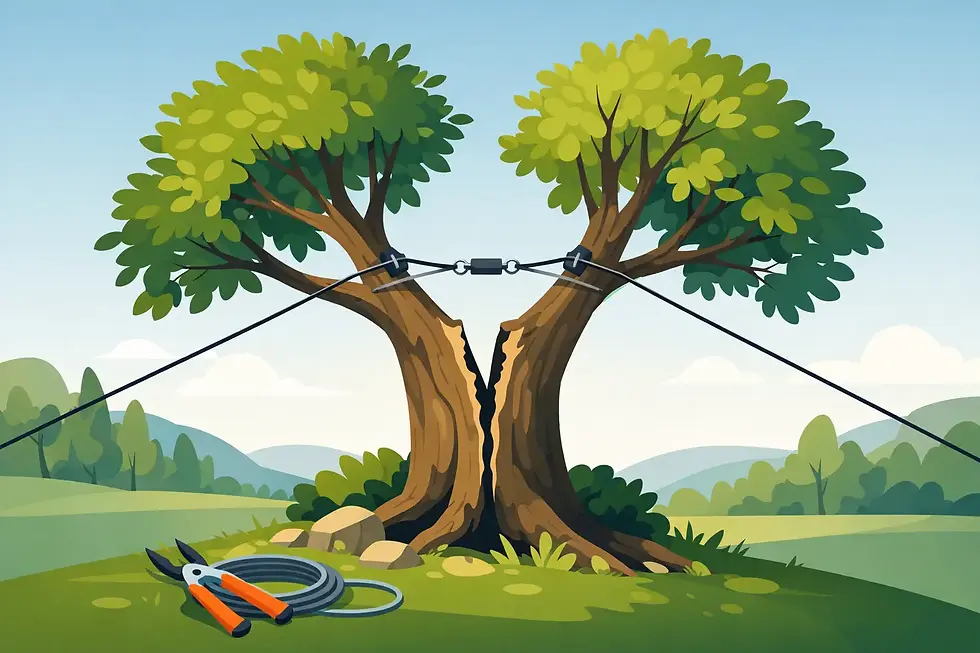
A certified arborist or qualified tree risk professional can also determine whether removal is necessary at all. Cabling, bracing, selective pruning, or habitat management may be appropriate when a valuable tree has a correctable structural issue. Those options are not a shortcut for a failing root system, but they can extend the safe service life of certain trees when the underlying condition supports it.
Do Not Wait for Wind or Snow to Make the Decision
Many leaning-tree calls begin after a storm, but the safest time to address a hazard is before severe weather arrives. Wind adds leverage to a leaning canopy. Wet snow can load branches beyond their capacity. Frozen ground and changing soil conditions can further complicate removal access and landing zones.
Do not assume a tree is safe because it made it through the last storm. Damage can accumulate gradually, and a root plate may continue to shift after the original weather event. Check leaning trees after strong winds, prolonged rain, heavy snow, construction activity, or excavation near the roots.
Emergency action is warranted when a tree has suddenly shifted, roots are lifting, the trunk is splitting, or the tree is resting against another tree or structure. Keep the area clear and arrange professional hazard mitigation as soon as possible. A tree that is partially supported by another tree is not stabilized. It is stored energy with an uncertain release point.
What Professional Removal Should Include
A qualified removal plan begins with a site assessment, not a chainsaw. The crew should identify targets, determine the likely failure direction, assess access, and select a removal method suited to the tree’s condition. For difficult removals, this can include climbing systems, rigging lines, lowering devices, cranes, or compact equipment designed to work within limited space.
The job should also account for the entire property, not just the trunk. Professional tree service includes protecting turf and landscaping where practical, managing debris, and leaving the work area clear and usable. Stump grinding may be added if the remaining stump creates a trip hazard, interferes with replanting, or limits future site use.
Ask direct questions before approving removal work. Confirm whether the provider is insured, whether certified arborist expertise is available, how they will protect nearby structures, and what debris removal is included. The lowest price can become the most expensive option if a crew lacks the equipment or planning needed for a controlled removal.
For high-risk removals in Bozeman, Belgrade, Big Sky, and surrounding communities, Climbing Dutchman Tree Service applies certified expertise, precision climbing, and rigging methods designed to protect people and property when a tree cannot simply be dropped.
Can a Leaning Tree Be Saved?
Sometimes. A young tree that leans after planting or a minor wind event may be able to recover with proper staking, soil correction, and monitoring. Mature trees are different. Trying to straighten an established, leaning tree can further damage roots and may create a false sense of security.
If the lean is longstanding and the tree shows healthy growth, no root disturbance, and no structural defects, an arborist may recommend monitoring rather than removal. Selective pruning can occasionally reduce canopy weight or wind exposure, but removing too much foliage can weaken the tree over time. Every recommendation should balance immediate risk, tree health, and the value of the surrounding property.
A leaning tree deserves prompt attention because its condition can change faster than it appears to. Keep people out of the fall zone, avoid improvised pulling or cutting, and have a qualified professional evaluate the risk before weather or gravity makes the decision for you.


Comments