
When to Book Tree Risk Assessment Services
- Callin Bos
- Apr 24
- 6 min read
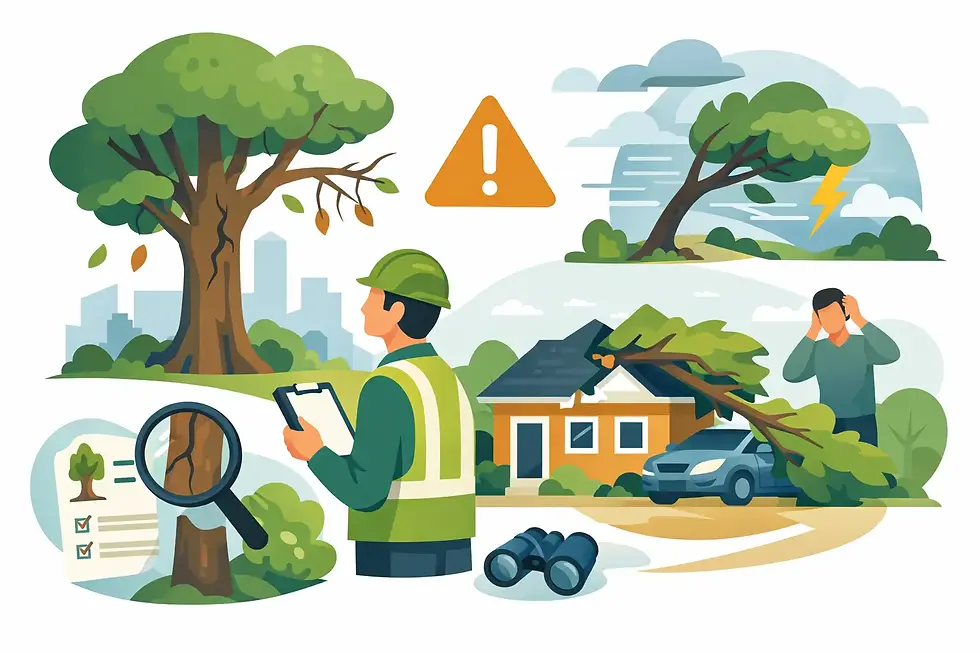
A leaning spruce after heavy snow, a cottonwood dropping large limbs over a driveway, or a mature tree with decay near a building is not a wait-and-see situation. Tree risk assessment services give property owners a clear, professional evaluation of what is stable, what is declining, and what needs action before a failure causes injury or damage.
For homeowners, HOAs, ranch properties, commercial sites, and managed landscapes in the Bozeman area, the question is rarely whether a tree matters. It usually does. The real question is whether that tree can be retained safely, or whether it has become a liability. That distinction takes trained judgment, not guesswork.
What tree risk assessment services actually do
Tree risk assessment services are designed to evaluate the likelihood of tree failure and the consequences if failure occurs. A professional assessment looks at the tree itself, the site conditions around it, and the targets that could be impacted, such as homes, garages, parked vehicles, walkways, fences, utility-adjacent areas, or places where people gather.
This is more than spotting a dead branch from the ground. A qualified arborist considers species characteristics, age, visible defects, structural weakness, root zone disturbance, storm damage, soil issues, previous pruning history, and signs of internal decay. In some cases, a tree may look full and green while carrying serious structural defects. In other cases, a tree with minor deadwood may still be fundamentally sound and manageable with corrective pruning.
That is why professional risk assessment matters. The goal is not to remove every imperfect tree. The goal is to identify actual risk, reduce it appropriately, and preserve healthy trees when that can be done responsibly.
Why risk changes faster than many property owners expect
Tree failure is often tied to cumulative stress. A tree may tolerate one issue for years, then begin to decline when a second or third factor is added. Drought, wet soil, root compaction, trenching, construction damage, heavy snow load, high winds, insect pressure, and poor pruning cuts can all shift a tree from manageable to hazardous.
Bozeman properties see a wide range of conditions that affect tree stability. Winter snow accumulation can overload weak branch unions. Wind exposure in open areas can reveal root instability. Dry periods can stress mature trees that are already dealing with restricted rooting space or old wounds. On rural and larger residential properties, wildfire planning may also change which trees should be retained, reduced, or removed.
Risk is also tied to occupancy. A tree in a back corner of acreage may have visible defects and still present a relatively low practical risk if there is little to hit. The same defect over a house, patio, storefront, parking area, or access road is a different matter. This is where experienced evaluation becomes critical. Hazard is not just about the tree. It is about the tree, the defect, and the target together.
Signs you should schedule tree risk assessment services
Some warning signs are obvious. Others are easy to dismiss until the damage is already done. If a tree has suddenly developed a lean, exposed roots, major dead limbs, splitting stems, cracked branch unions, hollow sections, fungal growth at the base, or soil heaving around the root plate, it should be evaluated promptly.
Less obvious signs also deserve attention. Repeated limb drop, thinning canopy, abnormal leaf size, dieback in upper crown sections, bark separation, cavities near structural attachment points, and trees that were topped or poorly pruned in the past can all indicate elevated failure potential. Trees growing over roofs, play areas, access drives, and commercial pedestrian zones deserve a higher level of scrutiny even when symptoms seem minor.
A recent storm is another reason to act. Wind and snow damage can create hidden structural issues that are not fully visible from the ground. A branch may remain attached after a storm but be cracked enough to fail later under a much lighter load. The same is true for partially compromised trunks and roots.
What a professional assessment should include
A credible risk assessment starts with a site-specific inspection, not a generic opinion. The arborist should evaluate tree structure, crown condition, scaffold branch attachments, trunk integrity, root flare condition, surrounding grade, soil disturbance, drainage, and target exposure. The outcome should be practical: what the risk appears to be, what factors are driving it, and what mitigation options make sense.
In some cases, the recommendation may be selective pruning to reduce end weight, remove deadwood, or improve structure. In other situations, cabling or bracing may help support a tree with a valuable canopy and a manageable defect. Sometimes the right answer is monitoring over time, especially when a defect is present but the failure likelihood remains low.
And sometimes removal is the only responsible option. That is especially true when structural integrity is compromised, targets are high-value or frequently occupied, and mitigation will not reduce the risk enough. A disciplined tree company will say that clearly. Keeping a dangerous tree in place to avoid a difficult conversation is not good arboriculture and not good risk management.
Tree risk assessment services are not the same as a free opinion
Many property owners have had someone point at a tree and say it looks fine or looks bad. That is not the same as a risk assessment. High-consequence trees near structures require a more careful process grounded in arboricultural knowledge, climbing and rigging awareness, and an understanding of how defects behave under load.
This is where certifications and field experience matter. An ISA-certified arborist brings technical training in tree biology, structure, and hazard evaluation. A CTSP-qualified professional adds a strong safety perspective that is especially important when recommendations may lead to pruning, cabling, or complex removals near homes and other assets.
The practical value is straightforward. Better assessment leads to better decisions. Better decisions reduce emergency failures, unnecessary removals, avoidable property damage, and liability exposure.
The cost of waiting is usually higher than the cost of evaluating
Property owners often delay assessment because the tree has been there for decades or because no failure has happened yet. That logic breaks down quickly when a large limb lands on a roof, blocks a driveway, damages vehicles, or injures someone. Emergency work is almost always more disruptive and more expensive than planned mitigation.
There is also the long-term cost of neglecting trees that could have been preserved with earlier intervention. A structural issue identified at the right time may be addressed with pruning or support systems. Wait too long, and the same tree may become unsalvageable. Risk assessment helps sort out which trees need urgent action and which need skilled maintenance to remain safe and healthy.
For commercial properties and managed sites, there is another layer: documentation and duty of care. If a tree presents visible defects in a high-traffic area, ignoring it can create avoidable exposure. A professional evaluation demonstrates that the risk was taken seriously and addressed with an appropriate plan.
Choosing the right provider for tree risk assessment services
Not every tree company approaches hazard work with the same level of discipline. For technically demanding sites, look for certified expertise, a safety-first operating standard, and direct experience with high-risk trees near buildings, fences, utility-adjacent spaces, and landscaped assets.
The best providers do not default to one answer. They do not recommend removal for every concern, and they do not downplay obvious hazards. They explain the condition, the level of concern, the likely progression, and the most defensible next step. That may be pruning, support, monitoring, or removal depending on the tree and the target.
Climbing Dutchman Tree Service approaches this work with that mindset. Precision matters when evaluating a compromised tree, and it matters even more when mitigation has to be performed without damaging the surrounding property.
When to act
If you are seeing visible defects, recent storm damage, decline in a mature tree, or overhanging limbs above valuable targets, schedule an assessment before the next weather event makes the decision for you. The right time for tree risk assessment services is before failure, not after cleanup has started.
A sound tree adds value, shade, and structure to a property. A compromised tree can take that value back in a single afternoon. Getting a professional opinion early is one of the simplest ways to protect your home, your landscape, and the people who use the property every day.
If a tree on your property is raising questions, that is reason enough to have it evaluated. Clear answers are safer than assumptions, and timely action is almost always cheaper than preventable damage.


Comments