
Case Study: Tree Removal Near a Garage
- Callin Bos
- Jul 16
- 6 min read
A mature tree can look stable for years until one lean, one weak union, or one hard Montana windstorm changes the risk. This case study of tree removal near a garage shows why the distance between a tree and a structure is only part of the equation. The real question is whether the tree can be removed without transferring the hazard to the roof, garage door, siding, vehicles, or people below.
The property was a residential lot in the Gallatin Valley with a large, declining deciduous tree positioned beside a detached garage. Its canopy extended over the roofline, and a major leader leaned toward the building. The owner had noticed deadwood in the upper crown and visible cracking near a co-dominant stem. With winter weather and heavy snow loads on the horizon, waiting for a failure was not a reasonable option.
This was not a job for a single cut from the ground. The garage sat inside the tree's natural drop zone, leaving no margin for a conventional felling approach. The removal required a controlled climbing and rigging plan designed around one priority: protect the structure while eliminating the hazard.
Case Study: Tree Removal Near a Garage
The first step was a site-specific hazard assessment. Before equipment was staged or a climber left the ground, the crew evaluated the tree's condition, lean, branch weight, decay indicators, access route, surrounding landscape, and available rigging points. They also identified the garage roof, gutters, overhead service considerations, fence line, and nearby planting beds as protected targets.
A visible crack at the stem union raised the stakes. A split or weak attachment can behave unpredictably when sections are loaded, especially if a climber removes weight from one side of the crown. The crew could not assume the remaining stem would hold as though it were sound wood. Every cut had to reduce force on the compromised area rather than increase it.
The plan called for sectional dismantling. Instead of trying to direct the full tree away from the garage, the climber would remove manageable limbs and trunk pieces from the top down. Each piece would be tied into a rigging system, lowered through a controlled path, and placed in a designated landing area clear of the building.
That approach takes longer than simply dropping material. It also requires specialized judgment. But when the alternative is a damaged roof, crushed garage corner, or injured person, speed is not the standard. Control is.
Why the tree could not be felled in one piece
A full-tree felling operation depends on having a clear landing zone that is long enough, wide enough, and free of valuable targets. This site had none of those conditions. The tree's height and canopy spread exceeded the available open space, while the garage was directly within the likely path of a misdirected fall.
Even a tree that appears to have room to fall can behave differently once the back cut is made. Internal decay, uneven crown weight, wind, frozen ground conditions, and defects at the hinge can alter its movement. A garage-adjacent tree with structural defects adds another layer of uncertainty. Professional hazard mitigation means removing uncertainty where possible, not betting a building on a cut that has little room for error.
The Controlled Removal Process
The crew established an exclusion zone around the work area before climbing began. No vehicles remained beside the garage, and access was controlled so residents, pets, and neighbors stayed clear of the lowering zone. Ground protection was installed where needed to limit damage to turf and landscape features.
From the canopy, the climber began by removing smaller outer limbs. This reduced sail area and took weight off the leaning side of the tree. Each limb was cut at a planned size, secured with rope, and lowered to the ground crew. The ground team managed friction devices and ropes to keep pieces from swinging into the garage, bouncing across the roof, or striking the fence.
The difference between lowering and dropping is substantial. A branch may weigh far more than it appears to from the ground, particularly when it is green, wet, or carrying multiple secondary limbs. A controlled rigging system allows the crew to manage that weight gradually. It also keeps the landing area compact, which matters on a residential property where every foot may contain a structure, garden, utility feature, or vehicle.
Once the upper crown was removed, the crew worked the remaining trunk in short sections. The compromised union required careful load management throughout this phase. The climber avoided shock loading the stem and selected cut lengths based on the available rigging capacity, wood condition, and distance to the garage. Larger sections were lowered slowly rather than allowed to free-fall.
As the trunk became shorter, the risk profile changed. The garage was no longer threatened by a broad canopy, but the crew still had to account for the remaining lean, stump height, root flare, and nearby work area. The final portion was removed only after the team confirmed it could be directed into the open landing space without contacting the building.
Protecting the garage beyond the roofline
Property protection is not limited to preventing a trunk from striking a roof. Garage doors can be damaged by side impact. Gutters can bend under even a relatively small limb. Siding can crack, and a falling branch can puncture shingles or damage roof vents. A poorly controlled limb can also rebound after ground contact and strike the building from below.
The crew planned for these secondary risks. Lowering lines were positioned to keep material away from the eaves. The ground crew communicated continuously with the climber before every significant cut. Materials were moved away from the structure as they came down, preventing a pile of brush or logs from becoming an obstruction or creating an uncontrolled bounce path.
This is where professional tree service differs from an improvised removal. The work is not just about getting a tree on the ground. It is about controlling the tree's energy from the first cut through final cleanup.
What the Homeowner Avoided by Acting Early
The most obvious avoided cost was damage to the garage. A large leader failing onto the roof could have led to repairs involving shingles, decking, fascia, gutters, and potentially the garage door or framing. If the failure occurred during a storm, water intrusion could compound the damage before repairs were possible.
There was also a personal safety issue. Detached garages are often high-traffic spaces, especially when homeowners store tools, outdoor gear, firewood, or vehicles inside. A failure does not need to bring down the whole tree to cause a serious injury. Dead branches and weakened leaders can fall without warning.
Acting before failure also gave the crew more options. The tree could be evaluated and removed on a planned workday, with the appropriate equipment and personnel in place. Emergency work after a storm is often more complicated because the tree may already be on a structure, tangled in utilities, or under tension. Conditions can be more dangerous, and the property damage has already occurred.
When Pruning May Be Enough and When Removal Is the Safer Choice
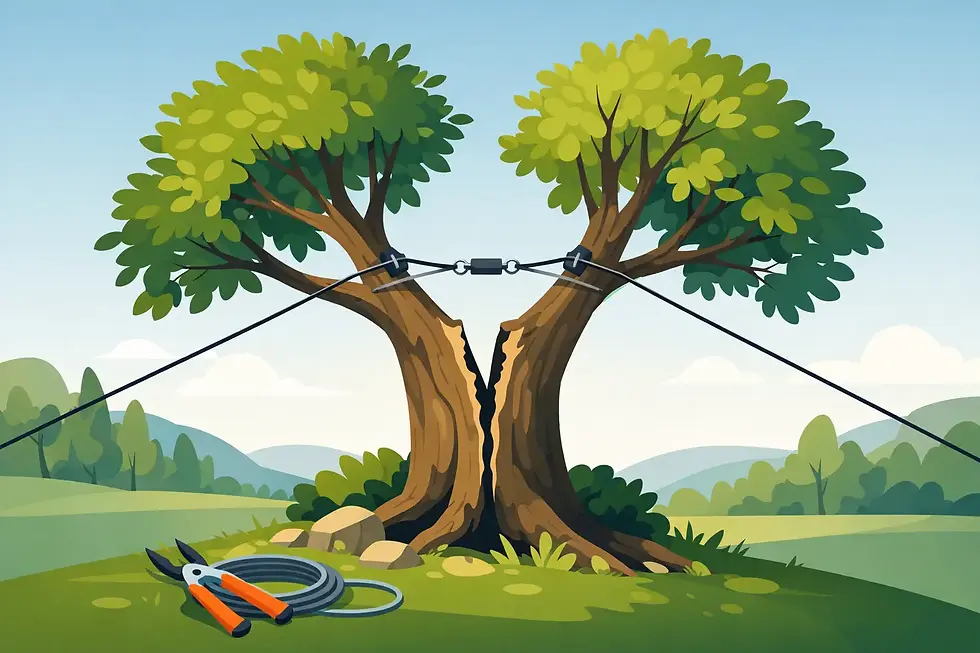
Not every tree near a garage needs to be removed. A healthy tree with sound structure may benefit from selective pruning to reduce end weight, remove deadwood, and improve clearance from the roof. Cabling or bracing may also be considered for certain trees with a correctable structural concern, depending on species, condition, defect type, and long-term management goals.
Removal becomes the stronger recommendation when defects are severe, decline is advanced, root stability is questionable, or the consequences of failure are too high. A tree leaning over a structure is not automatically hazardous, but a lean combined with decay, cracking, deadwood, soil movement, or poor branch attachments deserves prompt professional evaluation.
For property owners in Bozeman and surrounding Gallatin Valley communities, seasonal conditions add practical urgency. Snow loading, freeze-thaw cycles, saturated soils, and wind can expose weaknesses that were less obvious during calm weather. A trained arborist can distinguish between a tree that needs maintenance and one that presents an unacceptable risk.
The Result: A Clear Site and a Protected Structure
By the end of the project, the hazardous tree was removed without damage to the garage, roofline, fencing, or surrounding landscape. Brush and wood were processed from the site, and the owner could decide whether to retain wood chips, keep firewood-length material, or request hauling. Stump grinding could be scheduled if the remaining stump interfered with access, future landscaping, or construction plans.
The result was more than an empty space beside the garage. It was a safer property with a known hazard removed before weather, decay, or gravity made the decision on its own.
If a tree is growing over your garage, do not judge the risk by appearance alone. A professional assessment can identify whether targeted pruning, structural support, or controlled removal is the right next step before a manageable concern becomes a costly emergency.


Comments