
When Tree Cabling Systems Make Sense
A mature tree with a split trunk over a driveway is not a wait-and-see problem. Neither is a heavy lateral limb stretching over a roofline or parking area. In these cases, tree cabling systems can reduce the chance of structural failure and help preserve a valuable tree that might otherwise become a liability.
That said, cabling is not a shortcut and it is not a cure-all. It is a technical support method used in specific situations where a tree has a structural weakness but still has enough health, value, and long-term potential to justify retention. Done correctly, it can extend the safe life of a tree. Done poorly, it can create a false sense of security.
What tree cabling systems actually do
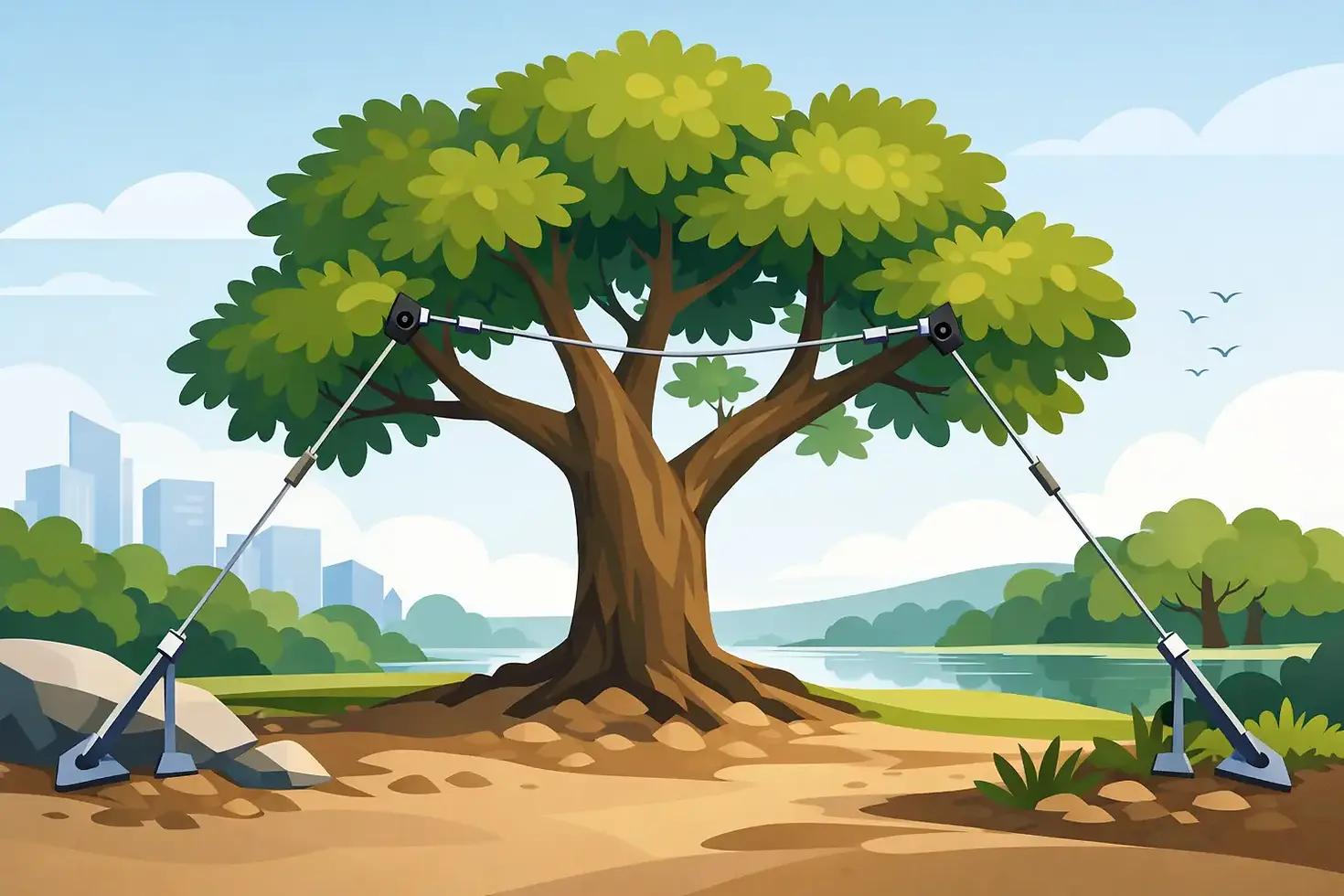
Tree cabling systems are installed to limit excessive movement between weak or overextended parts of a tree. The goal is not to make the tree rigid. Trees need natural movement to develop strength. The goal is to reduce the stress that wind, snow load, and limb weight place on a compromised union, stem, or branch.
In practical terms, cabling is often used when a tree has co-dominant stems with a weak attachment, a long heavy limb with a high failure risk, or a historic defect that cannot be corrected with pruning alone. A cable helps redistribute load so the weak point is less likely to split under pressure.
Bracing may also be recommended along with cabling. While cables are usually installed higher in the canopy to reduce movement, braces are threaded rods installed through stems or unions to add support at a weak attachment point. The right setup depends on the tree, the defect, the targets below, and the amount of movement that needs to be controlled.
When tree cabling systems are worth considering
Not every flawed tree should be cabled. Some should be pruned. Some should be removed. Some are too far gone to justify structural support. The decision starts with risk, tree condition, and target value.
A good candidate for cabling is usually a tree with meaningful landscape, shade, privacy, or historical value that also has a manageable structural defect. Think of a mature tree near a house, patio, garage, road, or commercial access point. If the tree is generally healthy but has a weak union or overextended limb, support may make sense.
Common examples include codominant stems with included bark, long lateral limbs over structures, and trees that have suffered storm damage but remain viable. In parts of Montana where wet snow and strong wind events can load trees hard, these defects become more than aesthetic concerns. They become property and safety concerns.
The other side of the equation matters just as much. If decay is advanced, root stability is compromised, or the canopy is in broad decline, cabling may only delay an inevitable failure. In that case, removal is often the safer and more cost-effective choice.
Why professional assessment matters before installation
The value of a cabling system depends on the accuracy of the diagnosis. You are not just supporting a branch. You are making a structural decision that affects safety, liability, and the future of the tree.
A qualified arborist evaluates species characteristics, defect severity, attachment strength, load distribution, canopy form, and site exposure. They also assess targets below the tree. A limb over open ground is one thing. A limb over a bedroom, sidewalk, fence line, or tenant parking area is another.
This is where homeowners and property managers can get into trouble with a simple visual guess. A crack may be active or old. A split may be shallow or extensive. A tree may look full and green while hiding decay at the union or root flare. Support systems should be prescribed based on tree biology and structural conditions, not optimism.
Static vs. dynamic cabling systems
There is more than one approach to tree support. In general, systems fall into two categories: static and dynamic.
Static systems use steel cable and hardware designed to significantly limit movement. These are often selected for more serious structural defects where movement needs to be tightly controlled. They require precise placement and hardware selection, and installation errors can damage the tree or reduce the system's effectiveness.
Dynamic systems use high-strength synthetic materials that allow more controlled movement. They are often used where some flexibility is beneficial and the defect is less severe. These systems can be appropriate for younger trees, developing unions, or situations where reducing shock load matters.
The right choice depends on the defect, tree species, age, and risk profile. A larger mature tree over a high-value target may call for a different system than a smaller ornamental tree in a lower-risk area. This is one of those places where it depends is the honest answer.
Cabling is rarely a standalone fix
A support system works best as part of a broader tree care plan. In many cases, selective pruning is performed along with cabling to reduce end weight and improve load distribution. Removing excess leverage from a long limb can reduce the amount of support required and improve the overall outcome.
Monitoring is also part of the job. Tree cabling systems need periodic inspection to confirm that hardware remains sound, the tree is responding well, and no new defects are developing. Trees grow, storms happen, and site conditions change. A system installed years ago may still be doing its job, or it may need adjustment, replacement, or a new risk assessment.
This is one reason cabling should never be sold as a permanent guarantee. It reduces risk. It does not eliminate it.
What property owners gain from a well-designed system
For the right tree, cabling can protect more than the canopy. It can help preserve shade, screening, curb appeal, and the character of a mature landscape while reducing the chance of sudden limb or stem failure.
There is also a practical financial benefit. Preserving a structurally compromised but valuable tree can be more cost-effective than full removal and replacement, especially when the tree contributes to energy shade, privacy, or site aesthetics. For commercial properties, reducing failure risk can also help limit exposure around walkways, parking areas, and occupied spaces.
Still, preservation should never come at the expense of safety. The point of cabling is to retain a tree responsibly, not avoid a hard decision.
Common mistakes with tree cabling systems
The biggest mistake is installing support on the wrong tree. If the tree is in serious decline, heavily decayed, or poorly rooted, a cable will not solve the underlying problem.
Another mistake is improper placement. Cables installed too low, too high, or without regard to load path may not provide meaningful support. Hardware selection matters too. The system has to match the size of the tree, the severity of the defect, and the forces involved.
A third issue is neglect after installation. Support systems require follow-up inspection. Without that, a property owner may assume the risk has been handled indefinitely, even as the tree changes over time.
Finally, there is the problem of treating cabling as a substitute for qualified pruning or removal. It is not unusual to find trees that would have benefited from early structural pruning but are later pushed into more complex support work because the problem was ignored. Timing matters.
How the decision should be made
If you are looking at a questionable tree near a home, driveway, barn, fence, or business entrance, the right next step is not to guess. It is to get a professional assessment that weighs structural condition, target risk, and realistic retention options.
A disciplined arboricultural approach asks a few basic questions. Is the tree healthy enough to keep? Is the defect supportable? Can pruning reduce the load? Is the target significant enough to justify intervention? Would removal actually be the safer and more economical option over time?
For property owners in areas like Bozeman, Belgrade, and the wider Gallatin Valley, those questions matter even more when snow load, wind exposure, and mature landscape trees intersect with homes and high-use outdoor spaces. Precision matters because the consequences of failure are real.
When tree cabling systems are properly specified and professionally installed, they can be an effective hazard-mitigation tool that preserves trees worth keeping. The key is knowing when support is justified, when it is not, and making the decision before the tree makes it for you.


Comments