
How to Identify a Dangerous Tree
- Callin Bos
- May 1
- 6 min read
A tree does not have to fall to be dangerous. In many cases, the warning signs show up months or even years before failure - if you know what to look for. Knowing how to identify a dangerous tree can help you prevent roof damage, blocked access, vehicle impact, utility issues, and serious injury on your property.
Some defects are obvious, like a split trunk or a large dead limb hanging over a driveway. Others are less visible and more serious, including root failure, internal decay, or structural weakness caused by poor attachment points. The goal is not to make every property owner into an arborist. It is to recognize when a tree may no longer be safe and when a professional assessment is the right next step.
How to identify a dangerous tree from the ground
Start with the whole tree, not just the canopy. Stand back far enough to see the trunk, major scaffold limbs, and the area around the base. A tree can look green and full from a distance and still have critical structural problems.
A sound tree usually shows balance, consistent leafing, and a trunk that appears solid and intact. A potentially hazardous tree often shows one or more visible defects. The most common include a sudden lean, large deadwood, cavities, cracked unions, peeling bark over dead sections, and root disturbance. One sign does not always mean immediate failure, but several signs together raise concern quickly.
Timing matters. A tree that looks questionable in calm weather may become a liability during wet snow, high wind, or heavy spring saturation. In Montana, those weather swings can expose structural weakness fast.
Dead or dying branches
Dead limbs are one of the clearest warning signs. If a branch has no leaves during the growing season, has brittle twigs, or sheds bark easily, that section may already be dead. Large dead branches over homes, decks, parking areas, or walkways deserve prompt attention because they can fail without much warning.
Not every dead branch means the entire tree is failing. Mature trees sometimes lose isolated limbs. But when deadwood appears throughout the canopy, or when the top of the tree is dying back, the issue may be deeper than simple pruning can solve.
Cracks in the trunk or major limbs
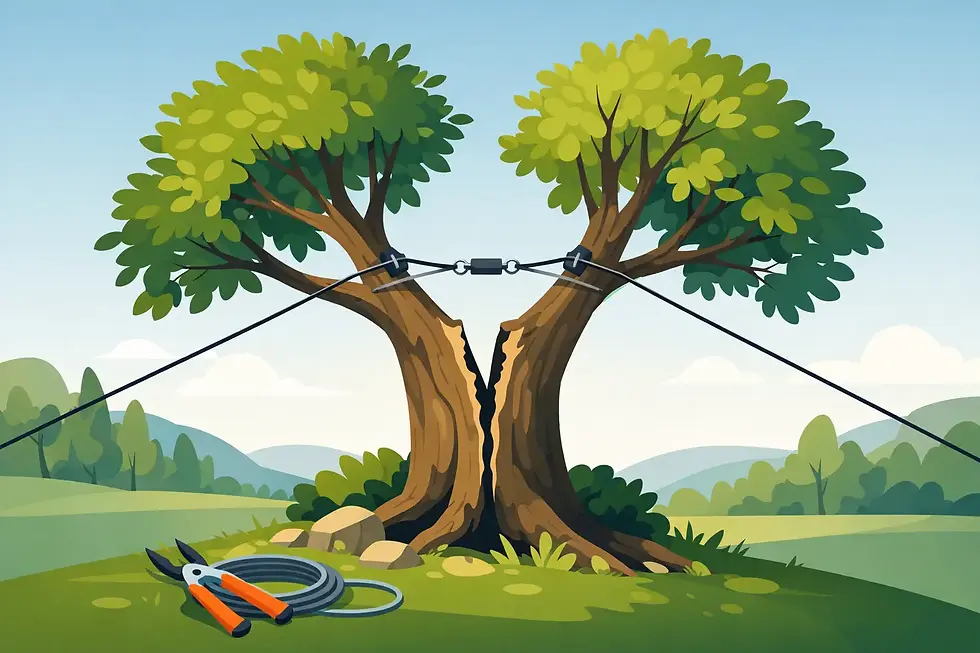
Vertical cracks, split trunks, and fractures where major limbs attach are serious defects. They can indicate that the wood fibers carrying the tree's load are already compromised. A crack may stay stable for a period of time, but under wind load or snow weight it can open further and fail suddenly.
Pay close attention to included bark at branch unions. This happens when two stems grow tightly together and bark gets trapped between them instead of forming a strong connection. From the ground, it may look like a narrow V-shaped attachment. These unions are common failure points, especially in co-dominant stems.
Cavities and decay
A hollow spot or cavity does not automatically mean removal is necessary, but it should never be ignored. Trees can compensate for some internal decay by adding strength around the damaged area. The problem is that you cannot accurately judge remaining structural wood from a quick visual guess.
Look for fungal growth at the base, soft or crumbly wood, deep cavities, or areas where the trunk appears sunken or swollen in an unusual way. Mushrooms near the root flare can signal root or butt rot, which is especially concerning because failure at the base often brings down the entire tree.
Signs a leaning tree may be unsafe
Many property owners focus on lean first, and for good reason. A tree that recently started leaning is one of the most urgent red flags. Sudden lean often points to root failure, soil movement, or storm damage.
That said, some trees naturally grow with a slight lean and remain stable for years. The critical question is whether the lean is new, increasing, or paired with other defects. Soil heaving, cracked ground, exposed roots on one side, or a lifted root plate are stronger indicators of instability than lean alone.
If a tree is leaning toward a structure, road, fence line, or area with regular foot traffic, risk goes up immediately. The target matters as much as the defect. A weak tree in an open field is different from the same tree over a house.
Root problems that often get missed
Root damage is one of the biggest reasons trees fail, and it is also one of the hardest issues for property owners to spot early. Most of the root system is below grade, so warning signs are indirect.
Construction activity is a major factor. If trenching, grading, excavation, or repeated heavy equipment traffic happened near a tree, stability may be compromised even if the canopy still looks normal. Severed roots reduce both anchorage and water uptake. Sometimes decline shows up later, after the root loss has already weakened the tree.
Watch for thinning leaves, undersized foliage, early fall color, dieback in the crown, or mushrooms near the base. None of these signs confirms root failure on its own, but together they suggest a tree under stress. Trees near newly altered drainage patterns can also decline when roots stay too wet or dry out unexpectedly.
Soil movement and exposed roots
When the ground around a tree starts cracking, lifting, or sinking, treat it seriously. Exposed roots, especially after erosion, can reduce support and leave the tree more vulnerable to windthrow. If the root flare is buried too deeply by fill soil or mulch, decay can develop around the base over time.
A healthy root flare should be visible at the base of the trunk. When the trunk disappears straight into the ground like a post, the tree may be planted too deep or have grade changes around it. That can contribute to long-term stress and hidden decay.
Canopy warning signs and species-specific stress
Leaf and needle issues do not always mean a tree is dangerous, but they can reveal declining health that leads to future structural problems. Sparse foliage, dead tops, one-sided canopy loss, premature needle drop, or large sections failing to leaf out are all worth attention.
In the Gallatin Valley, weather exposure, drought cycles, heavy snow load, and temperature extremes can all accelerate failure in already stressed trees. Cottonwoods, willows, spruce, pine, and aging ornamental species each fail in different ways. Fast-growing trees often develop weak wood or decay sooner than owners expect. Mature conifers may hold their form right up until root instability or trunk failure becomes advanced.
This is why species, age, site conditions, and defect history all matter. A visible crack in one species may be more urgent than the same-looking defect in another. That is where a trained risk assessment becomes more than a simple opinion.
When a dangerous tree needs immediate professional attention
Some situations should not wait for a routine estimate. If you see a newly leaning tree, a split trunk, hanging broken limbs, root plate movement, or storm-damaged wood over a target, keep people clear of the area and call a qualified tree professional.
The same applies if a tree is touching structures, overhanging occupied spaces, or threatening access points. DIY cleanup is where many property injuries happen. Tensioned wood, partially failed branches, and compromised stems are unpredictable. What looks like a simple cut from the ground can trigger a violent release of stored force.
For higher-risk properties, commercial sites, large homesites, rental properties, and trees near fences, roofs, or driveways, professional hazard mitigation protects more than landscaping. It reduces liability and helps prevent secondary damage from an avoidable failure.
How to identify a dangerous tree versus a tree that just needs pruning
Not every neglected tree is dangerous, and not every defect means removal. Sometimes the right solution is corrective pruning, weight reduction, cabling, bracing, or deadwood removal. The difference comes down to structural integrity, defect severity, and the consequences if the tree or branch fails.
A tree with isolated dead limbs but a sound trunk and stable root zone may respond well to professional pruning. A tree with multiple co-dominant stems, active cracks, decay at the base, and a target beneath it is a different category altogether. The decision should be based on risk, not appearance alone.
That is why certified evaluation matters. ISA-certified and CTSP-qualified professionals are trained to assess failure potential, target impact, and safe work methods in ways a visual guess from the ground cannot match. When the work involves climbing, rigging, or technical removal near structures, the quality of that judgment becomes critical.
If you are unsure whether a tree is hazardous, trust the uncertainty. A second look now is far less expensive than emergency removal after impact. For property owners in Bozeman and surrounding communities, that often means acting before wind, snow, or saturated soil turns a questionable tree into an immediate problem.
A dangerous tree rarely improves with time. If something looks off, sounds hollow, leans more than it used to, or is shedding large deadwood over a place people use every day, treat that as a prompt to get it evaluated and protect the property while you still have options.


Comments