
Structural Pruning Guide for Stronger Trees
- Callin Bos
- Jun 28
- 6 min read
A tree that looks full and healthy can still be developing weak structure. That is where a structural pruning guide matters. The goal is not cosmetic trimming. It is to direct growth early, reduce future failure points, and protect the tree, the people below it, and the property around it.
Structural pruning is one of the most valuable forms of preventive tree care because it addresses how a tree is built. Poor branch attachment, competing leaders, unbalanced crown development, and low permanent limbs can all turn into expensive problems later. In a place like southwest Montana, where snow load, wind, and seasonal stress can expose weaknesses fast, early correction has real value.
What structural pruning is really for
Structural pruning focuses on the long-term architecture of a tree. Instead of simply shortening branches or cleaning out deadwood, it identifies which limbs should become the tree's permanent framework and which ones are likely to create defects as the tree matures.
That distinction matters. Trees with codominant stems, included bark, overextended limbs, or poor branch spacing are more likely to fail under load. A young tree may tolerate those issues for years, then split during a storm or begin declining as one stem overwhelms the other. Correcting structure early usually means smaller cuts, lower stress, and better compartmentalization.
This is also why structural pruning is different from routine maintenance pruning. Maintenance work often manages clearance, removes dead material, or reduces interference with roofs, signs, driveways, and pedestrian areas. Structural pruning is more strategic. It shapes future strength.
A structural pruning guide starts with timing
The best time for structural pruning depends on species, age, condition, and the specific defect being corrected. In general, younger trees respond best because defects are smaller and easier to manage. Cuts are more likely to stay within a size the tree can close effectively.
For many deciduous trees, dormant season pruning offers a clear view of branch arrangement and can reduce stress. For some species, timing should avoid peak disease or insect activity. For others, light corrective work can happen at different times of year if the objective is hazard reduction or urgent clearance.
The key point is that there is no single calendar rule that fits every tree. A proper pruning plan is based on species traits, site conditions, and the tree's stage of development. That is one reason professional assessment matters, especially for valuable landscape trees or trees near structures.
What a certified arborist looks for
A sound structural pruning plan starts with a close inspection of the trunk, scaffold branches, branch attachments, crown balance, and spacing. The first question is usually simple: what should this tree look like at maturity, and what is getting in the way of that outcome?
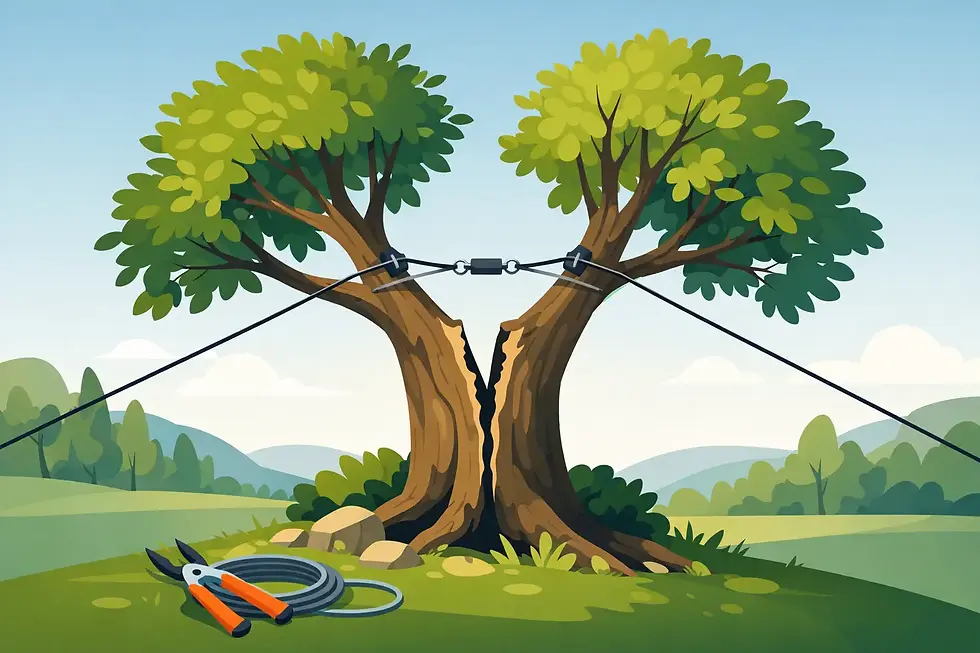
One common issue is codominant stems. These are two or more stems of similar size competing for dominance. They often form narrow attachment angles and included bark, which weakens the union. In snow or wind, that weak connection can split. Reducing one stem over time can improve stability, but the approach has to be measured. Removing too much too fast can shock the tree or create excessive exposure.
Arborists also look for temporary limbs that helped the young tree build trunk taper but should not remain as permanent structure. Those limbs may need gradual reduction rather than immediate removal, depending on trunk development and canopy balance.
Branch spacing is another major factor. Strong trees tend to have well-spaced scaffold branches arranged both vertically and radially around the trunk. When several major limbs emerge from the same point, the area becomes crowded and structurally weaker. Selective thinning and subordinating certain branches can improve future load distribution.
Structural pruning guide: what gets removed or reduced
In most cases, structural pruning is selective and restrained. It is not about taking a large percentage of canopy at once. It is about deciding which branches support long-term integrity and which ones create avoidable risk.
Common targets include competing leaders, crossing branches, weakly attached limbs, overextended laterals, and branches with poor spacing. In younger trees, this may also include reducing aggressive limbs that outgrow the intended central leader. In some ornamental species, the ideal form may differ, but the principle remains the same: develop a stable framework that can carry future growth without preventable failure.
Reduction cuts are often more appropriate than heading cuts because they preserve more natural form and direct growth to a suitable lateral. Improper heading cuts can create dense, weakly attached regrowth that solves little and creates more work later. Flush cuts are also a problem because they damage the branch collar and interfere with the tree's natural defense response.
This is where pruning quality matters as much as pruning intent. A good objective carried out with poor cut placement can still compromise the tree.
Why overpruning causes its own hazards
Property owners sometimes assume more pruning means more safety. That is not always true. Removing too much foliage reduces the tree's ability to produce energy, increases stress, and can trigger vigorous sprout growth. Those sprouts are often weakly attached and poorly structured.
Excessive canopy removal can also expose bark to sunscald, shift wind load to remaining limbs, and upset root-to-crown balance. On mature trees, heavy reduction can accelerate decline rather than improve performance. The result may be a tree that looks cleaner for a season but becomes less stable over time.
That trade-off is especially important for trees near homes, driveways, barns, commercial buildings, and public-use areas. If risk reduction is the goal, the pruning plan has to be grounded in tree biology and structural mechanics, not appearance alone.
Young trees offer the biggest return
If there is one practical takeaway from any structural pruning guide, it is this: early intervention is usually the smartest investment. A young tree with a minor structural defect can often be corrected with small cuts over a few pruning cycles. The same defect in a mature tree may require large reduction cuts, cabling, ongoing monitoring, or removal if the risk becomes unacceptable.
For homeowners and property managers, that means newly planted and juvenile trees deserve more attention than they often get. A tree that is allowed to grow unchecked for ten or fifteen years may already be carrying defects that are expensive to manage. By comparison, scheduled structural pruning when the tree is young can preserve form, reduce liability, and lower future maintenance costs.
When the work should not be DIY
There is a difference between removing a small broken twig and making structural decisions that affect a tree for decades. If the tree is large, near a building, above a fence line, close to service lines, or already showing signs of weak unions or imbalance, this is not casual yard work.
Improper pruning can create hidden defects, increase failure risk, and expose the property owner to avoidable liability. The physical hazard is obvious when climbing, using saws overhead, or working around targets. The less obvious risk is making the wrong cut in the wrong place and setting the tree up for future failure.
That is why structural pruning is best handled by qualified professionals who understand species-specific response, load management, cut selection, and safe access methods. An ISA Certified Arborist or a crew operating with strong safety and rigging standards can assess whether pruning is enough, whether support systems like cabling may help, or whether the tree's condition calls for a different plan.
What good structural pruning looks like over time
A well-pruned tree should not look butchered or artificially shaped. It should look balanced, natural, and increasingly stable as it matures. The best work often goes unnoticed because the tree simply develops the way it should have from the start.
That process may take multiple visits over several years. Not every defect should be corrected in one round. Subordinating a codominant stem, raising the crown gradually, or improving scaffold spacing often requires staged pruning to avoid overstressing the tree. Good arboriculture is disciplined. It respects both the objective and the limits of what the tree can tolerate safely.
For property owners in Bozeman and across Gallatin Valley, that long-view approach matters. Trees are not just landscape features. They are assets, shade sources, visual anchors, and in some cases serious liabilities if their structure is neglected. Professional tree care should protect all of those interests at the same time.
If you are looking at a tree and wondering whether a tight branch union, multiple leaders, or an unbalanced crown is a future problem, that is the right time to ask. The safest tree work usually starts before the defect becomes an emergency.


Comments