
Why Hire an ISA Certified Arborist?
- Callin Bos
- 6 days ago
- 6 min read
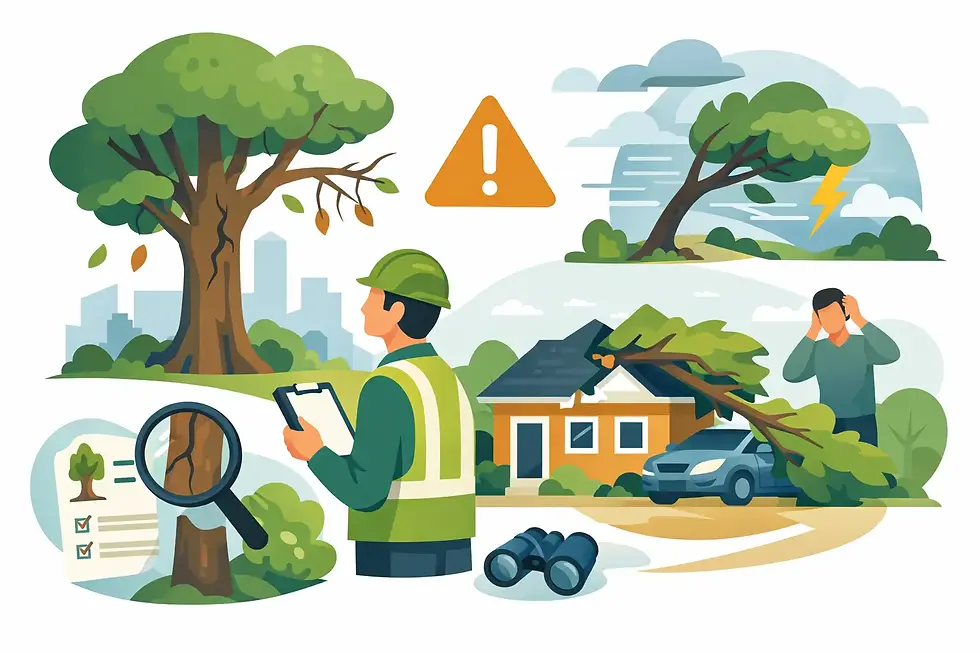
A heavy limb over a driveway, a pine leaning toward a roofline, a cottonwood with deadwood over a play area - these are not jobs for guesswork. When a property owner hires an ISA certified arborist, they are not just paying for someone to cut branches. They are bringing in trained judgment for tree health, structural risk, safe work planning, and protection of everything around the tree.
That distinction matters more than most people realize. Trees can add value, shade, screening, and character to a property, but when they are neglected or handled poorly, they can also become a liability. The right professional helps you avoid unnecessary removals, catch hazards early, and make decisions that protect both the landscape and the structures around it.
What an ISA certified arborist actually means
ISA stands for the International Society of Arboriculture. An ISA certified arborist has met experience requirements and passed an exam covering the core science and practice of professional tree care. That includes pruning standards, tree biology, diagnosis, soil management, safety considerations, and risk awareness.
For a property owner, the practical takeaway is simple. Certification shows that the person evaluating your trees has been tested on more than equipment use. They are expected to understand how trees grow, how defects develop, when pruning helps, when it harms, and how site conditions affect long-term stability.
That does not mean every certified arborist has the same level of field skill. Experience still matters, especially in technical removals, cabling, complex rigging, and work near homes, fences, and utilities. But certification is a meaningful baseline. It separates trained tree care professionals from operators who only know how to cut.
Why hiring an ISA certified arborist reduces risk
Tree work often looks straightforward from the ground. It rarely is. A cracked union may be holding more load than expected. A dead limb may be suspended over a target with no clear drop zone. A tree with internal decay may react unpredictably once weight is shifted.
This is where a certified arborist brings real value. The first job is not cutting. The first job is assessment. What is the tree species? What defects are present? What is the target zone? Is the issue health, structure, clearance, storm damage, or a combination of all four? Those answers shape the plan.
When that plan is wrong, the cost shows up fast. You can end up with topping instead of proper reduction, over-pruning instead of selective canopy management, or a rushed removal that damages turf, hardscape, roofs, or neighboring trees. On commercial sites and larger residential properties, poor decisions also increase liability exposure.
An ISA certified arborist is trained to think past the immediate cut. That matters if your goal is preserving a mature tree, reducing hazard potential, or deciding whether a failing tree can be retained with mitigation rather than full removal.
ISA certified arborist services go beyond pruning
Many property owners associate arborists with trimming. Pruning is only one part of the job, and often not the most critical one. A qualified arborist may be evaluating root stress from construction, identifying early signs of insect or disease pressure, determining whether a split stem can be supported, or assessing whether canopy density is increasing snow or wind load risk.
In high-consequence situations, the value is even clearer. Trees over structures, over access roads, near barns, around commercial parking areas, or close to gathering spaces require a disciplined approach. The work has to be planned around targets, fall paths, rigging points, worker positioning, and property protection.
That is why premium tree care companies place such a strong emphasis on certified expertise. Technical tree work is not just labor. It is hazard mitigation.
When certification matters most
There are routine jobs where almost any competent crew can handle the basics. There are also situations where the gap between average tree work and professional arboriculture becomes obvious.
If a tree is declining but still valuable to the landscape, certification matters. A trained arborist may identify reversible stress factors, recommend pruning that improves structure without compromising health, or catch a root issue before the canopy starts failing.
If the tree is near a house or commercial building, certification matters. Risk assessment and work sequencing become more important than speed.
If a tree has storm damage, codominant stems, included bark, visible cavities, dead upper canopy, or signs of root plate movement, certification matters even more. These are not cosmetic issues. They can point to structural failure potential.
In wildfire-conscious areas, certification also becomes highly relevant. Fuel reduction, ladder fuel management, spacing, and selective pruning need to be handled with an understanding of both fire behavior and plant response. Aggressive cutting can solve one problem while creating another if it weakens retained trees or encourages poor regrowth.
What to ask before hiring an arborist
Not every company that advertises tree service operates at the same level. If the work affects safety, buildings, valuable trees, or access areas, it is reasonable to ask direct questions.
Ask whether an ISA certified arborist will be involved in the assessment and work plan. Ask how the company approaches hazard evaluation. Ask whether the recommendation is preservation, mitigation, or removal, and why. If pruning is proposed, ask what standard or objective guides the cuts.
You should also pay attention to how they talk about the job. A qualified professional should be able to explain the risk, the likely outcome, and the trade-offs in clear terms. Sometimes the safest recommendation is removal. Sometimes it is selective reduction, cabling, deadwood removal, or monitoring over time. The right answer depends on the tree, the site, and the target below it.
A serious company will not default to the cheapest-looking solution if it creates a larger problem later.
Why the cheapest bid often costs more
Tree work is one of those services where underqualified labor can look economical right up until something goes wrong. Poor pruning can trigger decay, weak regrowth, and long-term structural defects. Incomplete removals can leave unstable remnants. Improper cuts near buildings can lead to immediate property damage.
There is also the hidden cost of bad advice. If a healthy tree is removed unnecessarily, you lose shade, screening, and landscape value. If a hazardous tree is left standing because the evaluator missed key defects, the financial exposure can be much worse.
Hiring an ISA certified arborist does not guarantee the lowest estimate. It often means you are paying for informed decision-making, better work planning, and a lower chance of avoidable damage. On properties with mature trees, expensive hardscape, fences, driveways, and structures, that difference is easy to justify.
The Montana factor: trees deal with real stress here
In the Gallatin Valley and surrounding areas, trees contend with wind, snow load, temperature swings, drought pressure, and site disturbance from construction and landscaping. Those conditions can expose weaknesses quickly. A tree that looks acceptable in summer may show structural problems under snow, or lose major limbs after a wind event.
That is one reason professional assessment matters so much for local property owners. Mature spruce, cottonwood, ash, pine, and ornamental trees each respond differently to pruning, storm stress, and site changes. A one-size-fits-all approach is not good enough when the tree sits over a home, parking area, livestock enclosure, or public-facing property.
For that reason, companies like Climbing Dutchman Tree Service build their work around certified evaluation, hazard awareness, and precision execution. On difficult sites, that is what protects both the tree and the property.
Good arboriculture is not always about saving every tree
This is where honesty matters. A certified arborist is not there to preserve every tree at any cost. Sometimes a tree is too compromised, too poorly attached, too decayed, or too badly placed to justify retention. In those cases, removal is not a failure. It is the correct risk-management decision.
What you want is a professional who can tell the difference between a tree that needs care and a tree that needs to come down. That judgment is what property owners are really paying for.
If you are looking at overhanging limbs, visible defects, storm damage, or trees that no longer feel stable near your home or business, treat the issue early. The best time to bring in an ISA certified arborist is before a preventable problem turns into an emergency. A careful evaluation now usually gives you more options, lower risk, and better outcomes later.


Comments