
What Does an Arborist Inspect?
- Callin Bos
- Jul 6
- 5 min read
A tree can look fine from the driveway and still have a serious structural problem over your roof, driveway, fence, or pedestrian area. That is usually the point behind asking, what does an arborist inspect? A qualified arborist is not just looking at whether a tree is green and growing. The inspection is focused on risk, long-term health, structural stability, and the potential for failure under wind, snow load, saturation, or age-related decline.
For property owners, that difference matters. A casual opinion might miss decay, root plate instability, included bark, or storm damage that puts people and structures at risk. A professional inspection is meant to identify what can be corrected, what needs monitoring, and what has become unsafe.
What does an arborist inspect on a tree?
An arborist starts with the whole tree, not just one visible problem. The goal is to understand how the tree is growing, how it is supported, what defects are present, and how the surrounding site affects its condition. That means the inspection often moves from the canopy down to the trunk, into the root zone, and then outward to nearby targets such as homes, garages, roads, play areas, power lines, sheds, parked vehicles, and walkways.
This broader approach matters because tree risk is rarely caused by one issue alone. A cracked leader may also be tied to poor branch attachment. A thinning canopy may be connected to root damage. Deadwood in the crown may be the visible symptom, while the more serious defect is internal decay or compacted soil below.
Canopy condition and crown health
The canopy tells an arborist a great deal about the tree's current vitality. They look for dead limbs, hanging branches, uneven leaf density, sparse growth, early leaf drop, discolored foliage, broken tops, storm damage, and sections of canopy dieback. In many cases, the crown is where stress first becomes obvious.
That said, a thin canopy does not always mean the tree is failing, and a full canopy does not always mean the tree is sound. Species, season, recent weather, insect pressure, and site conditions all affect appearance. A trained inspection separates normal variation from decline that suggests disease, root stress, or structural compromise.
Branch structure and attachment points
One of the most important parts of an inspection is branch architecture. Arborists evaluate scaffold limbs, codominant stems, overextended limbs, weak unions, crossing branches, and attachments with included bark. These defects can increase the chance of splitting under wind or snow.
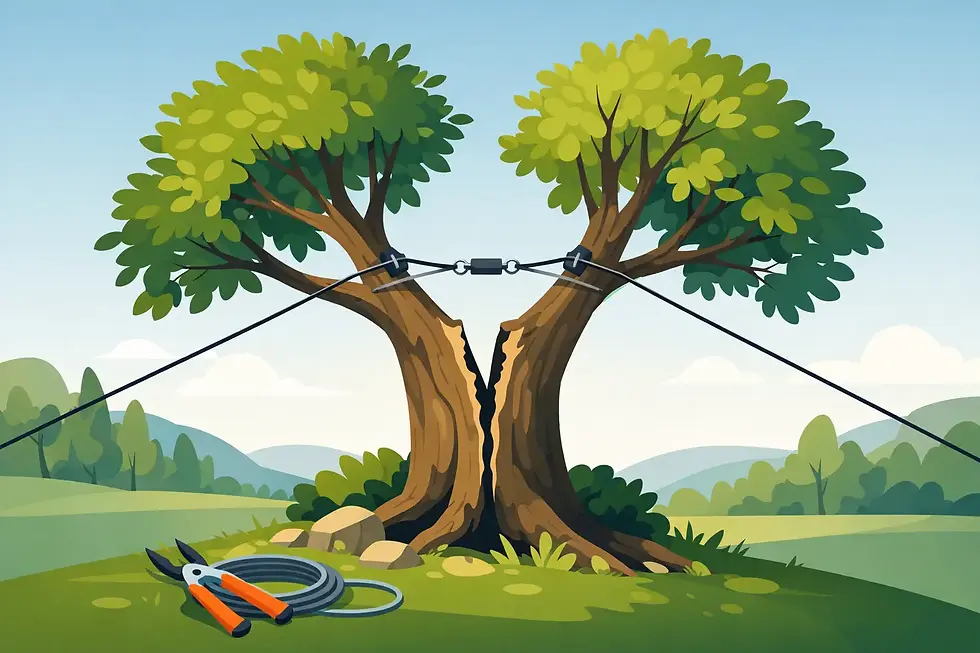
This is especially important for mature shade trees over homes, commercial lots, and high-use outdoor spaces. A limb does not need to be dead to fail. Sometimes the highest-risk branch is alive, heavy, poorly attached, and positioned directly over a target. In those cases, pruning, cabling, bracing, or reduction may be recommended depending on the species, defect severity, and value of the tree.
Trunk defects, decay, and stability concerns
The trunk is where arborists look for signs that a tree's load-bearing capacity may be compromised. They inspect for cracks, cavities, seams, bulges, old woundwood, missing bark, decay pockets, lightning scars, fungal fruiting bodies, insect activity, and previous improper cuts. Even a single vertical crack can be significant if it extends through a major union or indicates active separation.
Surface signs do not always tell the full story. Some trees compartmentalize decay well and remain manageable for years. Others can appear stable while losing significant internal strength. That is why inspection is based on patterns, location of defects, species characteristics, and likelihood of failure, not just the presence of a hollow spot or cavity.
Leaning is another area that requires judgment. Not every lean is dangerous. Some trees naturally developed that way and have adjusted over time. A recent lean, fresh soil lifting, cracking near the base, or root plate movement is a different matter and may signal imminent instability.
Root flare, root zone, and soil conditions
Many serious tree problems start below grade. Arborists inspect the root flare to see whether the trunk enters the ground normally, whether there is girdling, burial, rot, or mechanical damage, and whether the base shows signs of decay or restricted growth. The visible root flare often provides early warning of a larger issue.
They also assess the root zone and surrounding soil. Compaction from traffic, trenching, grade changes, irrigation problems, saturated conditions, drought stress, and construction damage can all reduce root function and stability. If roots have been cut for utilities, hardscape, or excavation, the tree may still look acceptable for a period before decline or failure starts to show.
This is one reason inspections near new building work, driveway expansion, and landscaping changes are so valuable. Root damage often goes unnoticed until the crown declines or the tree becomes unstable in a storm.
Pest, disease, and environmental stress
An arborist also checks for insect activity, pathogen indicators, and stress symptoms linked to site conditions. That can include cankers, boring holes, sap flow, fungal growth, scale activity, woodpecker feeding patterns, leaf spotting, abnormal bark texture, or signs of vascular disease. In Montana landscapes, weather exposure and drought stress can be just as important as insects or disease organisms.
This part of the inspection is not just about naming a problem. It is about determining how much the issue affects tree function and whether intervention is realistic. Some pest or disease issues can be managed with pruning, sanitation, soil improvement, watering adjustments, or monitoring. Others create structural degradation that changes the risk profile even if the tree still appears green.
Site exposure and target assessment
A tree is inspected in relation to what it could hit if it fails. This is a core part of professional risk assessment. Arborists look at occupancy and target value, including structures, vehicles, utility corridors, outdoor seating, livestock areas, access roads, sidewalks, and neighboring property.
They also consider site exposure. Wind patterns, slope, drainage, prevailing weather, snow load, and fire-prone conditions all influence how a tree should be managed. A defect that may be tolerable in an open field is less acceptable over a house, shop, parking area, or busy entrance.
For larger rural and semi-rural properties, vegetation density and ladder fuels may also be part of the inspection. In wildfire-conscious areas around the Gallatin Valley, tree condition and spacing can affect both defensible space planning and post-storm cleanup risk.
What an arborist inspects beyond the tree itself
A thorough inspection often includes previous pruning work, clearance from structures, interference with roofs or chimneys, and contact risk with service lines. Poor pruning history can create weak regrowth, decay entry points, or overextended weight at the ends of limbs. Arborists are also watching for trees that were topped, wounded by equipment, or left with stubs that changed the way the crown develops.
In many cases, the recommendation is not removal. Professional tree care is often about preserving a valuable tree while reducing the specific defects that make it hazardous. But there are times when the inspection shows the opposite - that repeated pruning will not correct the underlying instability, decay, or site conflict. That is where honest assessment matters.
Why inspection findings are rarely one-size-fits-all
Two trees can show the same symptom and need very different responses. A cavity in one species may be manageable with regular monitoring and load reduction. In another, paired with poor branch unions and a high-value target, it may justify removal. The same goes for lean, deadwood, root loss, or crown thinning.
That is why a real inspection is not a checklist with automatic answers. It depends on species, age, defect location, site use, recent weather, and what is within striking distance. Certified expertise matters most when the decision has consequences for safety, liability, and property protection.
If a tree is close to a house, showing signs of decline, dropping large limbs, leaning after a storm, or growing over a high-use area, waiting for obvious failure is the expensive option. A professional tree inspection gives you a clearer picture of what is stable, what needs correction, and what should not be left to chance. When safety, structural integrity, and long-term property protection are on the line, a trained arborist is inspecting far more than the tree's appearance.


Comments