

8 Best Ways to Protect Property From Tree Damage
A mature tree can add real value to a Montana property, but one compromised limb over a roof, driveway, fence, or power line can change the equation quickly. The best ways to protect property begin with recognizing that tree risk is not always obvious from the ground. Sound decisions require attention to structure, species, site conditions, weather exposure, and the consequences if a tree or limb fails.
For homeowners, landowners, and property managers, proactive tree care is not cosmetic maintenance. It is a practical form of hazard mitigation that protects buildings, vehicles, utilities, people, and the long-term health of the landscape.
1. Identify Hazard Trees Before They Fail
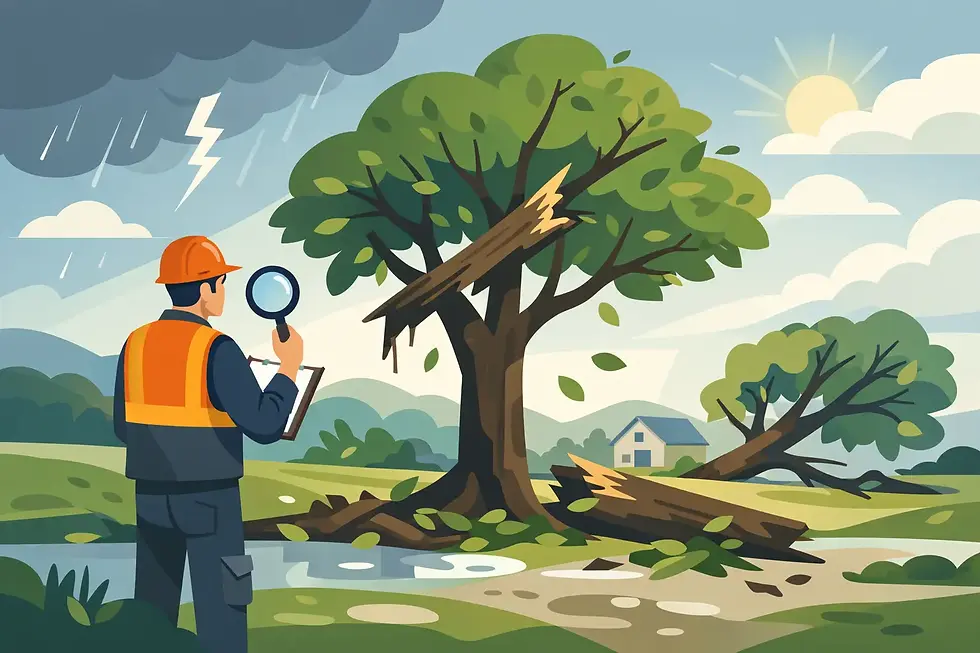
A tree does not need to be dead to present a serious risk. Trees can look green and healthy while carrying decay inside the trunk, weakened root systems, poorly attached co-dominant stems, or cracks at major branch unions. A heavy snow event, high wind, or saturated soil may be all it takes to expose the weakness.
Watch for dead or hanging limbs, cavities, mushroom growth near the base, peeling bark, visible cracks, leaning trunks, soil heaving around roots, and branches extending over structures. Sudden leaf loss in one portion of the canopy can also point to a problem. These signs do not always mean immediate removal is necessary, but they do justify a professional assessment.
The stakes are higher when the tree is within striking distance of a house, garage, deck, parking area, road, or neighboring property. In those locations, the question is not simply whether a tree may fail. It is what it could damage if it does.
2. Use Professional Pruning to Reduce Failure Risk
Proper pruning is one of the most effective property-protection measures available. Removing dead, damaged, crossing, or poorly positioned limbs reduces the weight and wind resistance in the canopy while directing growth away from roofs, chimneys, windows, and service lines.
However, aggressive cutting can create a new problem. Topping, indiscriminate thinning, and removing too much live canopy can stress a tree, stimulate weak regrowth, and leave large wounds that invite decay. A tree that is cut cheaply today may become a larger hazard later.
Professional pruning is selective. It accounts for branch attachment, load distribution, tree biology, clearance needs, and the species' ability to respond. For mature trees near a structure, the goal is not to make the tree look smaller at any cost. The goal is to reduce predictable points of failure without sacrificing stability or health.
Keep Clearance Around Buildings and Access Areas
Branches should not scrape siding, rest on roofs, block visibility, or obstruct driveways and walkways. Contact between limbs and a roof can damage shingles, gutters, and fascia while giving rodents and insects an easier route to the structure.
Clearance also matters for emergency access and routine maintenance. A blocked driveway or low branch over a parking area can create avoidable property damage, especially for delivery vehicles, snow removal equipment, and commercial traffic. The right clearance depends on the site, tree species, and use of the space.
3. Address Structural Defects With Cabling or Bracing
Some valuable mature trees have structural weaknesses that can be managed rather than removed. Co-dominant stems with included bark, long heavy limbs, and split-prone branch unions may benefit from properly designed cabling or bracing systems.
These systems are not a substitute for an evaluation. They must be installed in the right tree, at the correct location, and often alongside corrective pruning. A cable can reduce movement and lower the likelihood of a split, but it cannot make a severely decayed or fundamentally unstable tree safe.
When preservation is appropriate, support systems may extend the useful life of a significant shade tree and reduce the chance of damage to nearby assets. When preservation is not appropriate, removal is the more responsible decision. This is where qualified arboricultural judgment matters most.
4. Remove Trees That Cannot Be Made Safe
A hazardous tree beside a home is not a do-it-yourself project. Trees close to structures often require technical climbing, controlled rigging, sectional dismantling, and a clear plan for protecting roofs, fences, landscaping, and underground utilities.
Removal is often warranted when a tree has extensive decay, major root damage, severe lean toward a target, repeated limb failures, storm damage, or disease that has compromised its structure. Dead standing trees deserve particular attention because wood becomes less predictable as it deteriorates.
The least expensive bid is not always the lowest-cost outcome. Improper cuts, uncontrolled drops, damaged turf, broken fences, and injury liability can turn a simple removal into an expensive incident. Certified, safety-focused crews use the equipment and work practices needed to control risk in confined or complex spaces.
5. Protect the Root Zone During Construction and Landscaping
Many tree failures begin years before the tree comes down. Grading, trenching, soil compaction, changes in drainage, and equipment traffic can injure roots and destabilize trees over time. By the time canopy decline becomes visible, the damage may already be significant.
Before building an addition, installing utilities, widening a driveway, or reworking a landscape, identify the trees worth preserving and establish protection around their root zones. Keep heavy equipment, soil stockpiles, and material storage outside those areas whenever possible. Avoid cutting major roots without professional guidance.
This is especially relevant on established properties where large trees have grown around homes, garages, and outdoor living areas. Protecting the roots protects the tree's ability to stand through wind, snow load, and seasonal moisture changes.
6. Reduce Wildfire Fuel Around Structures
In Gallatin Valley and surrounding communities, vegetation management is a direct property-protection measure. Dense brush, deadfall, low limbs, and crowded conifers can carry fire closer to a home, outbuilding, fence line, or access road.
Creating defensible space does not mean clearing every tree from the property. It means reducing the continuity of fuels so a ground fire has fewer paths to climb into the canopy or advance toward a structure. Removing dead material, pruning lower limbs where appropriate, thinning overcrowded growth, and managing brush can materially improve site conditions.
Fire break work should reflect the property layout, slope, vegetation type, and surrounding fuels. A selective approach preserves useful shade and screening while reducing the hazards that matter most. Ongoing debris removal is part of the work, because cut material left in place can become fuel itself.
7. Prepare for Storms Before the Forecast Changes
Snow load and wind are routine realities in southwest Montana. A storm inspection is most effective before branches begin breaking, not after a limb is already resting on a roof.
Schedule attention for trees with previous storm damage, long horizontal limbs, overextended leaders, or known decay. Check for branches over roofs and parked vehicles, and do not wait for a large limb to fall before addressing it. If severe weather is expected, move vehicles away from obvious targets and keep people clear of damaged or hanging branches.
After a storm, treat split limbs, downed trees near utility lines, and partially uprooted trees as hazards. Do not attempt to cut bent, loaded, or suspended wood without the right training and equipment. Stored tension can release suddenly and violently.
8. Make Tree Risk Reviews Part of Property Maintenance
The most reliable way to avoid emergency tree work is to inspect trees regularly. A seasonal walkthrough can reveal new cracks, deadwood, drainage changes, pest activity, soil movement, or branches encroaching on a structure. Property managers should also document concerns and prioritize trees near high-traffic areas.
Professional assessments are particularly valuable after major weather events, construction activity, or noticeable changes in a mature tree. An ISA-certified arborist can help distinguish between a manageable maintenance issue and a condition that requires prompt removal or structural support.
The Best Ways to Protect Property Start With a Clear Plan
Tree care decisions should be based on risk, not guesswork or appearance alone. A healthy-looking tree may need targeted pruning; a declining tree may need removal; and a valuable mature tree may be a candidate for cabling, bracing, or root-zone protection. Each choice depends on the tree and what stands beneath it.
For complex hazards near homes, commercial buildings, fences, or access areas, Climbing Dutchman Tree Service provides professional tree service built around precise execution and uncompromised safety. A timely estimate and qualified assessment can prevent a manageable concern from becoming a costly property-loss event.


Comments