
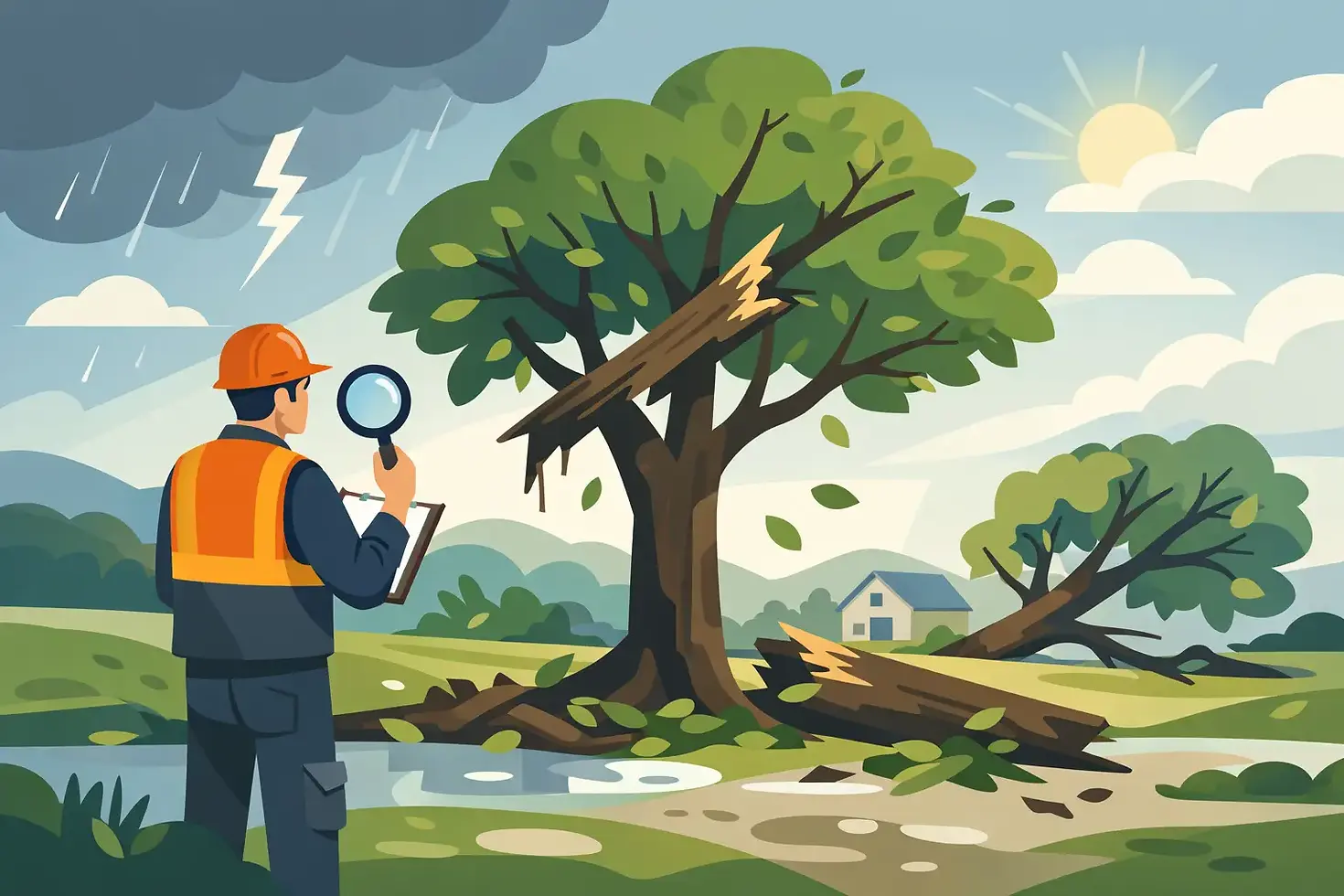
How to Assess Storm Damaged Trees Safely
A storm can leave a tree looking mostly intact while hiding a serious structural failure above your driveway, roof, fence, or walkway. The goal when you assess storm damaged trees is not to decide whether you can handle the work yourself. It is to identify immediate hazards, secure the area, and know when trained tree professionals need to take over.
In Gallatin Valley, high winds, heavy wet snow, ice loading, and saturated soil can all change a tree's stability quickly. A limb that remains suspended after a storm may fall without warning. A tree that leans only slightly may have a damaged root system beneath the soil. Treat post-storm inspection as a property-safety task, not routine yard cleanup.
How to Assess Storm Damaged Trees From the Ground
Wait until the storm has fully passed and conditions are safe enough to be outdoors. Do not walk beneath damaged branches, work around downed power lines, or enter an area where a tree has shifted toward a structure. If a limb or trunk is touching electrical equipment, keep everyone well back and contact the utility provider or emergency services as appropriate.
Begin your inspection from a distance. Walk the property slowly and look upward before moving beneath the canopy. Take photos from several angles, especially if a tree is near your house, garage, vehicles, public sidewalk, or neighboring property. Good documentation can help with insurance conversations and gives a tree care professional a clearer starting point.
Look for Changes in the Tree's Position
A new lean is one of the most important warning signs after wind or soil-saturating rain. Compare the tree to nearby buildings, fence lines, or other trees. A lean that existed before the storm may not be an emergency, but a sudden change in angle can indicate root plate failure.
Check the ground around the base from a safe distance. Raised soil, fresh cracks in the ground, exposed roots, or a mound of soil lifting on one side of the trunk may mean the root system is moving. Do not try to push, pull, brace, or straighten the tree. Those actions can trigger the final failure.
Inspect the Trunk and Major Limb Attachments
Look for new splits, long cracks, missing bark, or seams that have opened in the trunk. Pay close attention to where major limbs join the trunk. Weak unions can separate under snow or wind load, leaving large sections partially attached and highly unstable.
A broken limb is not automatically a removal situation. Smaller, cleanly broken branches in an open area can often be pruned properly to support recovery. The trade-off changes when a limb is large, hanging, torn at the trunk, or positioned over a target such as a roof, patio, play area, road, or parked vehicle. In those situations, the risk is less about appearance and more about the likelihood and consequence of failure.
Watch for Hanging or Suspended Limbs
Tree professionals often refer to broken branches caught in the canopy as hangers or widowmakers. They can be difficult to see from directly below and may drop when wind resumes, temperatures rise, or another branch shifts.
Keep people, pets, and equipment outside the fall zone. Do not shake the tree, throw ropes into the canopy, climb it, or use a ladder to cut overhead material. A homeowner-grade chainsaw and ladder are a particularly dangerous combination after a storm because the wood is under tension, the footing may be unstable, and the cut piece can move unpredictably.
Signs a Storm-Damaged Tree Needs Urgent Attention
Some damage can wait for a scheduled pruning assessment. Other conditions call for prompt hazard mitigation. Arrange professional help quickly when you see any of the following:
A tree or large limb is leaning toward a home, occupied building, driveway, road, or pedestrian area.
The trunk has split, a major leader has failed, or a large branch remains torn and suspended in the canopy.
Soil is heaving around the base, roots are exposed, or the tree has developed a new and obvious lean.
A tree has contacted a power line, utility pole, service line, or electrical equipment.
A damaged tree is blocking access for vehicles, emergency services, tenants, or business operations.
A tree does not have to be on the ground to be hazardous. Partially failed trees frequently require more technical planning than fully fallen ones because crews must control unstable wood while protecting structures below.
What Storm Damage Means for Long-Term Tree Health
The first question is usually, “Can the tree be saved?” The answer depends on the species, age, condition before the storm, extent of canopy loss, root damage, structural defects, and location. A healthy mature tree with a limited branch failure may recover well after corrective pruning. A tree with a split trunk, severe root disturbance, or extensive crown loss may no longer have a safe or sustainable structure.
Avoid making decisions based only on how much green foliage remains. Trees can leaf out after a storm and still have compromised trunks or roots. Conversely, a tree that looks rough immediately after damage may be a good candidate for skilled pruning and monitoring. An ISA-certified arborist can distinguish between manageable branch damage and defects that make retention unreasonable near people or property.
Cabling and bracing may be appropriate in certain situations, such as a valuable tree with a correctable structural weakness. It is not a cure for a severely failed tree, nor should it be used as a reason to keep a tree that presents an unacceptable target risk. The right recommendation is based on the whole site, not a one-size-fits-all repair.
What Not to Do After a Storm
Do not begin cleanup by cutting the largest pieces first. Storm-damaged wood can be under compression, tension, or both. Once cut, a trunk or limb can roll, spring, twist, or drop in a direction that is hard to predict. Even experienced crews use planned cuts, controlled rigging, specialized equipment, and exclusion zones to manage those forces.
Do not top a damaged tree in an attempt to make it safe. Topping creates large wounds, encourages weak regrowth, and often leaves a more hazardous structure over time. Proper pruning removes damaged material at appropriate branch unions while preserving as much sound canopy and natural form as practical.
Also resist the urge to cover wounds with paint or sealant. Most pruning wounds are best left clean and properly cut so the tree can begin its natural compartmentalization process. The exception is not a product on the wound but a professional evaluation when disease, pests, or extensive bark damage are involved.
Protect the Site While You Wait for Service
Your immediate job is to control access. Move vehicles out of the possible fall zone if it can be done without entering danger. Keep children, pets, visitors, and maintenance staff away from damaged trees. Use cones, temporary barriers, or clear signage around walkways and parking areas when appropriate.
For commercial properties and rental locations, document the hazard and communicate restrictions promptly. A blocked sidewalk, hanging limb over a parking area, or tree leaning toward an entrance can create liability long before the tree actually fails. Timely action protects people and demonstrates responsible property management.
You can remove small, loose twigs from open ground if there are no overhead hazards and no power lines nearby. Leave anything requiring a ladder, chainsaw, climbing, or work near a structure to qualified personnel. This is where professional tree service delivers real value: identifying hidden failure points, selecting the safest access method, and removing or retaining material without creating additional damage.
When to Call a Certified Tree Professional
Call for an assessment when the storm damage involves large limbs, a compromised trunk, root movement, difficult access, utilities, or any tree near a meaningful target. The urgency increases when the tree is over a home, road, deck, fence, commercial lot, or neighboring property.
Climbing Dutchman Tree Service provides hazard-focused evaluations and precision removal, pruning, cabling, and debris management for demanding situations throughout the Bozeman area. Certified expertise matters when a damaged tree needs more than a quick cut. The work must account for wood tension, structural defects, controlled lowering, access limitations, and the protection of the property around it.
A storm does not always make the decision for you, but it often reveals the condition a tree was already hiding. Give damaged trees space, make careful observations from the ground, and act early when the structure no longer inspires confidence. A timely professional assessment can preserve a recoverable tree or prevent a preventable loss.


Comments