
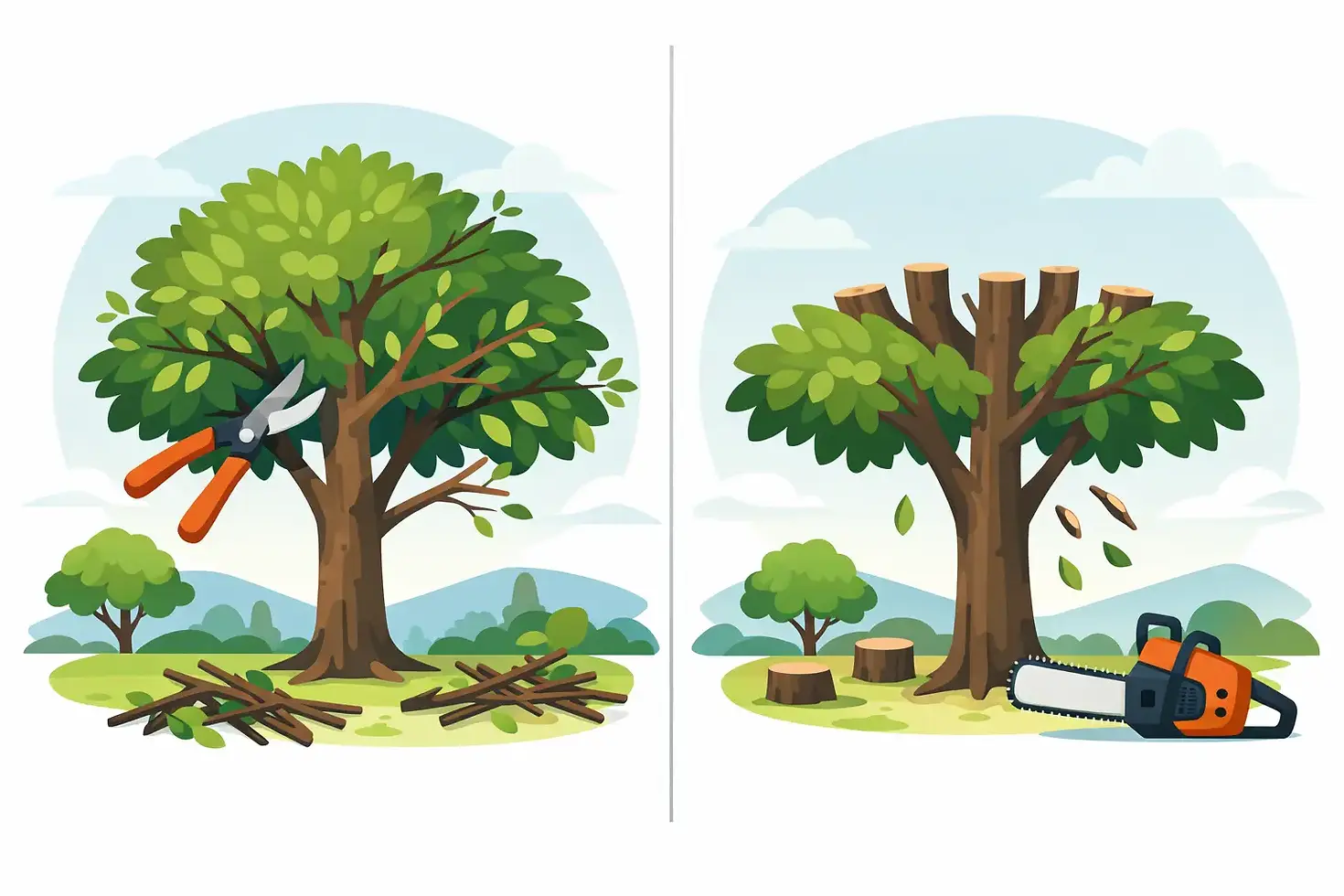
Pruning vs Topping Mature Trees
A mature tree can add real value to a property - until someone cuts it the wrong way. When property owners ask about pruning vs topping mature trees, the issue is usually not cosmetic. It is about clearance over a roof, heavy limbs over a driveway, storm risk, or a canopy that feels too large for the space. The method you choose affects tree health, structural stability, and the level of risk around your home or commercial site.
Topping and pruning are not interchangeable. One is a recognized arboricultural practice when performed correctly. The other is typically a destructive shortcut that creates larger problems over time.
Pruning vs topping mature trees: what is the difference?
Pruning is the selective removal of branches to improve structure, reduce risk, provide clearance, or support long-term tree health. On a mature tree, proper pruning is guided by branch biology, weight distribution, decay potential, and the tree's ability to respond to cuts.
Topping is the indiscriminate cutting back of large branches or the main stem to stubs or lateral branches that are too small to assume the terminal role. In plain terms, it means taking the top out of a tree or cutting major limbs back hard to reduce height quickly.
That difference matters. Proper pruning works with the tree's natural architecture. Topping overrides it.
Why topping mature trees creates more risk
A topped tree often looks smaller right away, which is why some property owners are tempted by it. But that short-term reduction usually comes with long-term consequences.
When large limbs are cut back to stubs, the tree loses a significant amount of leaf area. That leaf area is how the tree produces energy. A mature tree already has less flexibility than a young one, so severe canopy loss can trigger stress, decline, and weak regrowth.
That regrowth is one of the biggest hazards. After topping, many species respond by producing clusters of fast-growing shoots near the cuts. These shoots are weakly attached, especially compared with naturally developed scaffold branches. As they elongate, they become more likely to fail in wind, snow load, or ice.
Topping also creates large wounds. Mature trees do not "heal" in the way people do. They compartmentalize damage. The larger the cut, the harder that process becomes. Oversized cuts increase the chance of decay moving into structural wood, which can turn a tree that once needed routine maintenance into a removal candidate.
If the tree is close to a house, garage, fence, parking area, or pedestrian space, that is not just a tree health issue. It becomes a liability issue.
What proper pruning actually does
Proper pruning can reduce risk without stripping the tree of its natural form. The objective is not to make a mature tree unnaturally small. It is to improve its structure and manage specific conflicts.
Depending on the species, condition, and site, professional pruning may involve crown cleaning to remove dead, broken, or diseased limbs. It may involve selective reduction to shorten overextended branches back to suitable laterals. It may also include crown raising for clearance over driveways, walkways, roofs, or sightlines.
The key is selectivity. Every cut should serve a purpose. On a mature tree, that means balancing clearance needs with the amount of live canopy that can be removed without causing unnecessary stress.
This is where experience matters. A large cottonwood over a house, an aging spruce with heavy end weight, and a mature maple showing included bark do not get pruned the same way. The species, defect load, and target area all change the plan.
Why mature trees require a different standard
Young trees can often recover from poor cuts better than older trees. Mature trees have more mass, more exposure, and more consequences when they fail. They also have established structural patterns that should be respected, not reshaped aggressively.
That is why pruning vs topping mature trees is not a minor technical distinction. On a mature tree, bad cuts can create a cycle of repeated maintenance, progressive decay, and rising hazard. What starts as an attempt to control size can end in emergency limb failure or full removal.
For property owners in places like Bozeman and the wider Gallatin Valley, snow, wind, and seasonal weather swings make structural integrity even more important. Weakly attached regrowth and large topping wounds are not good combinations in a region where trees are routinely exposed to loading events.
When height reduction is necessary
There are cases where a tree is simply too large for its location. It may interfere with utility clearance, overhang a structure, crowd another valuable tree, or present an unacceptable loading risk. But even then, topping is usually not the right answer.
A better option may be reduction pruning, if the species and tree architecture allow for it. Reduction pruning shortens branch length by cutting back to lateral branches large enough to assume terminal growth. It still changes the size of the tree, but in a way that preserves branch structure more effectively than topping.
That said, not every mature tree is a good candidate for reduction. Some species tolerate it poorly. Some have already been over-pruned in the past. Some are so compromised by decay, poor form, root issues, or storm damage that pruning will not make them reasonably safe.
In those situations, removal may be the more responsible recommendation. That is not upselling. It is risk management.
Signs a topping proposal should concern you
If a contractor recommends cutting the tree "flat across the top" or taking all branches back to the same height, that is a red flag. So is language about making the tree easier to manage without any mention of species response, cut size, structural defects, or long-term regrowth.
A credible tree care professional should be able to explain what is being removed, why those cuts are appropriate, and how the work will affect the tree over time. They should also be able to tell you when pruning will not solve the underlying problem.
For mature trees near homes and high-value targets, the conversation should include safety, defect assessment, drop zones, rigging needs, and property protection. Precision matters as much as plant knowledge.
The cost question property owners usually ask
Some owners choose topping because it appears cheaper than skilled pruning. On the day the work is done, that can be true. Over the life of the tree, it often is not.
A topped tree commonly needs repeated corrective work. It may decline faster, become unsightly, or develop hazardous regrowth that requires removal later. If decay advances into major stems, the cost and complexity of future work can increase substantially, especially over structures or in confined access areas.
Proper pruning is more deliberate. It takes judgment, climbing skill, and an understanding of how to reduce risk without creating new defects. That level of work protects value rather than sacrificing it.
What to expect from a professional assessment
A professional assessment starts with the tree's condition, not with a preset cutting method. The arborist should look at species, age class, defects, prior pruning history, branch attachments, deadwood load, clearance conflicts, site targets, and signs of root or trunk problems.
From there, the recommendation may be selective pruning, structural mitigation such as cabling or bracing, periodic monitoring, or removal. The right answer depends on the whole risk picture.
At Climbing Dutchman Tree Service, that is the standard serious tree work requires. Mature trees near homes, barns, fences, commercial buildings, and traffic areas should be managed with certified judgment and controlled execution, not shortcuts.
A better way to think about tree size
Many mature tree problems are really site planning problems that show up late. A tree outgrows its space, branches extend over valuable targets, and owners understandably want the canopy reduced fast. But forcing an oversized mature tree into a smaller shape through topping rarely fixes the root issue.
The better question is not, "How much can we cut off?" It is, "What level of pruning preserves safety and structure, and if that is not enough, is this tree still appropriate for the site?"
That question leads to better decisions. Sometimes it preserves a high-value tree for years. Sometimes it prevents wasted money on a tree that is already declining. Either way, it protects the property owner from the false economy of a bad cut.
If a mature tree on your property feels too large, too heavy, or too close for comfort, do not ask for topping as the default. Ask for a professional evaluation of the actual risk, the actual structure, and the safest path forward.


Comments